Vault Guide — envelope encryption for ~/.euler
This guide covers the per-user vault: the envelope-encryption scheme that keeps a
collaborator's X25519 private key and project env encrypted at rest, how the key reaches the
processes that need it, and how the terminal and the browser each unlock it. It is implemented
in packages/solver/solver/crypto/vault.py, with every interactive part in
packages/solver/solver/crypto/keys.py.
Related: SRP Guide — where the salt and the browser-derived key come from; Git Filter Guide — what the private key ultimately opens; Secret Sharing Guide — how that private key comes to hold the master key in the first place.
1. What it is, and what it is not
Two files in the machine-local secrets directory are worth protecting:
| file | what it is |
|---|---|
~/.euler/id |
the X25519 private key — it unwraps the master key, and through it every private solution |
~/.euler/env |
the project env, including ANTHROPIC_API_KEY |
Before the vault, both rested in plaintext with 0600 permissions inside a 0700 directory.
That is real protection against other users of the machine and none at all against the
machine's operator, a backup, or a stray copy of a home directory. On the deployed web host
every collaborator's secrets sit in a home directory root can read — which is precisely the
case the vault addresses.
With a vault, both files rest as ciphertext under a key that only the collaborator's password derives.
The boundary, stated honestly: this is at-rest opacity against a passive or honest operator. An active root can read a live session's memory or modify the shared solver code; no design protects a secret from the entity that controls the CPU. The module docstring says the same thing in the same words — this is not "zero-knowledge", and should never be described so.
2. Envelope encryption, and why
Two keys, not one:
password ──Argon2id("euler-vault-pk:" ‖ salt)──▶ PK ──AES-256-GCM──▶ wrapped VK   (~/.euler/vault)
                                                                        │
                                                                        ▼ unwrap
                                                                       VK ──AES-256-GCM──▶ id, env
VK— the vault key: 32 random bytes that encrypt the secrets themselves.PK— the password key: 32 bytes derived from the password, used only to wrapVK.
Where the vault sits in the whole chain, from sign-in to a decrypted solution (VK is the step
inside "unlocks"):
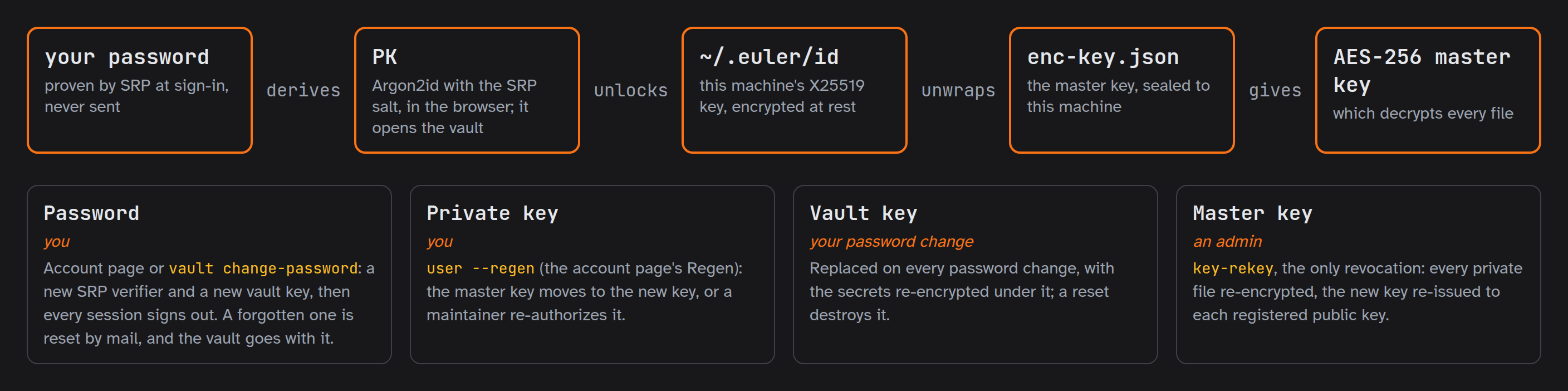
Encrypting the secrets directly under PK would be simpler and worse: the envelope is what
lets the browser hold PK without ever holding the key to the file contents.
A password change re-keys the vault (rekey_vault, rekey_vault_with_pk): a fresh VK,
every vault-encrypted file (id, its rolling backups, env) re-encrypted under it, and the new
VK wrapped under the new PK. Merely re-wrapping the old VK would leave a VK that leaked
before the change — out of a session key file, say — opening everything after it. The set of
files is small, and the change is crash-safe by one commit point: each file is first staged
beside its original as <name>.rekey, the vault file is replaced atomically, and only then are
the staged files renamed into place. A crash before the commit leaves the old vault intact; a
crash after it leaves staged files the new VK opens, which the next unlock moves into place
(_settle_rekey), dropping any it cannot open.
The change then ends every session that still holds the old VK. The auth service already
ends every other web session on a password change and closes the live web shell; the page that
made the change signs itself out too, and the next sign-in opens the re-keyed vault. In a
terminal, vault change-password writes the new VK into the shell's key file in place
(replace_session_key), so that shell keeps working; any other open shell must be restarted.
The KDF: Argon2id
PK = Argon2id(password, "euler-vault-pk:" ‖ salt, m = 64 MiB, t = 3, p = 1, len = 32)
The parameters are one string, argon2id$m=65536,t=3,p=1 (wire.VAULT_KDF, mirrored in
vault.js), and the vault records it in its own file, so the cost can rise later without
stranding anybody. The browser derives the same PK with the vendored hash-wasm it already loads
for the SRP key (base.html); the terminal uses argon2-cffi. Every guess at a stolen
~/.euler/vault — readable only by its owner's uid and root — costs 64 MiB of Argon2id, the same
as a guess at a stolen users.json.
Vaults were PBKDF2-SHA256 (600 000 rounds) until v4.15: WebCrypto-native, so there was no
implementation to ship into the page — until the SRP key needed one anyway. Every vault was
re-wrapped under Argon2id at its next unlock (same VK, same salt), and the PBKDF2 path is gone.
The salt is 16 bytes — and on the web path it is the account's SRP salt, which the browser
already has from the login challenge (SRP Guide §8).
The salt is public by construction in both systems; sharing it couples nothing but the input to
two independent derivations — both Argon2id at the same cost, but each labels its salt
("euler-vault-pk:" here, "euler-srp-x:" for SRP), so they never compute the same function of
the password.
The ciphers
Both layers are AES-256-GCM with a random 96-bit nonce — authenticated encryption, so a
wrong key or a corrupted blob raises InvalidTag rather than returning plausible garbage. That
is what makes "wrong password" a clean failure everywhere in this module.
| blob | layout | function |
|---|---|---|
wrapped VK |
hex( nonce ‖ AES-GCM(PK, VK) ) |
wrap_vault_key / unwrap_vault_key |
| a secret file | MAGIC ‖ nonce ‖ AES-GCM(VK, plaintext) |
encrypt_secret / decrypt_secret |
MAGIC is b'VLT\x01' (config['vault_magic']) — a 3-byte tag and a format version. It is
what lets is_vault_encrypted tell ciphertext from plaintext, which in turn makes
encrypt_secret idempotent and decrypt_secret a pass-through for files that were never
encrypted. Every migration path in the module leans on that: a vault can be initialised over a
mix of plain and already-encrypted files with no special cases.
Random nonces are safe here because the blob count per key is tiny — two files, rewritten by hand. This is the opposite choice from the git filter, which must be deterministic: it derives its nonce from the plaintext by HMAC so identical content yields identical ciphertext and git sees no churn (Git Filter Guide §2). Two schemes, two requirements; neither one's rule may be carried to the other.
3. The files
| path | mode | contents |
|---|---|---|
~/.euler/ |
0700 |
the secrets dir — a sibling dot-directory named for the repo, outside the checkout |
~/.euler/vault |
0600 |
{kdf, iterations, salt, wrapped_vk} (VaultData) |
~/.euler/id |
0600 |
X25519 private key, PKCS8 PEM — vault-encrypted when a vault exists |
~/.euler/id.1 … .5 |
0600 |
rolling backups (config['private_key_backups']), each in whatever form it was written |
~/.euler/env |
0600 |
KEY=VALUE project env — vault-encrypted when a vault exists |
~/.euler/vault holds no secret: without the password it is {salt, wrapped_vk} and a round
count. It is still 0600, because there is no reason to hand an attacker the salt.
Nothing here is ever in the checkout, and nothing here is ever committed. (The one piece of key material that is committed — half the master key — is not a secret at all; see the Secret Sharing Guide.)
4. Getting VK to the processes that need it
The code that needs VK does not run in the shell. load_private_key runs inside the git
clean/smudge filter: a short-lived subprocess git spawns with its own environment and a stdout
that carries file content. So the key has to survive process boundaries without being prompted
for again and without being printed.
interactive shell ── unlock_session() ──▶ VK ──▶ write_session_key()
                                                     │
                          $XDG_RUNTIME_DIR/euler/vk-XXXX   (tmpfs, 0600, uid-private)
                                                     │
                      os.environ['EULER_VAULT_KEY_FILE'] = <that path>
                                                     │
                       inherited by every child: git filter, solver subprocesses
The path is in the environment; the key is in a uid-private file on tmpfs. That split is
deliberate: a process's environment is readable from /proc/<pid>/environ by anyone who can
read the process, whereas a 0600 file in $XDG_RUNTIME_DIR is cleared at logout and reachable
only by the uid.
session_vault_key() resolves it once per process (lru_cache), in this order:
- the key file named by
$EULER_VAULT_KEY_FILE, when it exists and is exactly 32 bytes; $EULER_VAULT_PASSWORD, unwrapping the vault directly — the non-interactive path for a script, CI, or a setup run. It costs a full Argon2id per process, which is why a shell callsensure_session_key()at startup to materialise the file and let its children take path 1.
There is no password file, and that absence is a decision: a password stored beside the
ciphertext it unlocks protects nothing the 0600 directory does not already protect, while
looking like it does.
Ownership. Only the process that created a key file removes it, via _own_key_file →
atexit (keys.py). A file this process merely inherited must be left alone: on the web path
the per-user service writes it and shares it across every shell that user has open, so cleaning
it up on one shell's exit would lock out the others and the service's own session.
clear_session_key() is the deliberate teardown — logout, and vault reset.
_resolve_session_key must never prompt: it is on the git-filter path, in a subprocess with no
terminal. A vault it cannot open is simply locked, and recovery is the shell's job.
5. Terminal usage
The shell unlocks once at startup — packages/solver/solver/main.py calls
unlock_session(interactive=config.subject.channel == 'terminal'), so a terminal is asked for
the password and a web shell never is (it already has VK from the service, §6).
vault                    # status (the default): does a vault exist, what is encrypted, can this session decrypt
vault init               # create it and migrate the existing plaintext id/env into it, in place
vault unlock             # retry after a typo, or once you have the password to hand
vault change-password    # new password, new vault key: the secrets are re-encrypted under it
vault status answers three separate questions and distinguishes states that look alike:
| line | meaning |
|---|---|
No vault. |
id/env rest in plaintext — the pre-vault state, not an error |
vault: present · session unlocked |
this process tree holds VK |
vault: present · session locked |
the vault exists and nothing here can open it |
encrypted (decrypts) |
the session key actually opens that file |
encrypted — the session key does NOT decrypt it |
a foreign or stale VK — flagged, not hidden |
BROKEN: … vault-encrypted but ~/.euler/vault is missing |
the key is unrecoverable; see §8 |
Non-interactive use puts the password in the environment:
EULER_VAULT_PASSWORD='…' solver "eval 101" # unlocks without a prompt or a tty
A locked session is not a broken one. load_private_key raises a clear ValueError, the git
filter cannot decrypt, and so the private solutions and claude-api are unavailable —
everything else in the shell works normally. After vault change-password the command warns
when $EULER_VAULT_PASSWORD is still set: it now holds the old password, and the next
non-interactive unlock will fail until it is updated.
6. Web usage
The browser derives PK itself and sends only PK — to the signed-in user's own service,
never to the auth service, and never as a password:
sign-in (auth service, SRP)                  per-user service (runs as the collaborator's uid)
  password stays in the page                   POST /vault/unlock  {pk, salt}
  PK = Argon2id(password, SRP salt)              → unlock_vault_with_pk(pk)         (returning user)
  sessionStorage: euler.vault.pk                 → init_vault_from_pk(pk, salt)     (first login)
                                                 → write_session_key(VK)
                                               POST /vault/rekey {old_pk, new_pk, new_salt}
                                                 → a password change re-keys the vault
                                                   (then the page signs out)
vault.js keeps PK in sessionStorage — this tab only, gone when the tab closes — because
PK can unwrap VK and is handled as a secret: never logged, never sent anywhere but the
user's own origin. The service-side twins of the password functions
(unlock_vault_with_pk, init_vault_from_pk, rekey_vault_with_pk) exist precisely so the
password itself never has to cross the wire to be useful.
Because the per-user service is the collaborator's uid, write_session_key in that process
exports EULER_VAULT_KEY_FILE into the service environment, and every PTY the service forks
inherits it (packages/webshell/euler_webshell/ws/pty.py passes dict(os.environ)). That is why a web shell is
already unlocked and is never asked for a vault password: asking would be a prompt nobody can
see, in a shell attached over a WebSocket.
First login initialises the vault rather than failing on its absence — with the account's
SRP salt, so the terminal path and every later browser session derive the identical PK — and
encrypt_secret_files immediately migrates any plaintext id/env in place. A vault must
never coexist with plain secrets beside it.
7. Password reset destroys the vault
An SRP reset re-mints the login verifier. It shares nothing with the vault, so the old PK is
gone and the old VK can never be unwrapped again. reset_vault() therefore removes the
vault file, every vault-encrypted secret file (id, its rolling backups, env), and the
session key.
This is not data loss caused by the reset — the data became unreachable the moment the password
was forgotten. Leaving the blobs in place would only misrepresent the state, and would make
vault init look like a repair when it would in fact be a fresh vault beside permanently
unreadable files.
Plaintext files are never touched: they were never under this vault.
Afterwards the collaborator re-provisions. user --regen mints a new identity and files a key
request; a maintainer answers it with authorize <message-id>, which records the new public key
in the roster and sends half the master key sealed to it
(Secret Sharing Guide §5). Any env secrets are re-entered.
8. Failure modes
| symptom | cause | what to do |
|---|---|---|
git fails on private solutions in a terminal |
the vault is locked, so the filter cannot decrypt | vault unlock, or set EULER_VAULT_KEY_FILE / EULER_VAULT_PASSWORD for the process |
your identity file exists but cannot be read |
the vault is locked, or a foreign VK |
fix the vault — never user --regen past it: that orphans the real identity and any authorization it carries |
BROKEN: id, env are vault-encrypted but ~/.euler/vault is missing |
the vault file was lost | restore it from backup, or recover deliberately (user --regen for the id, re-create env) |
vault init refuses |
orphaned encrypted files (as above) | resolve the orphans first; a fresh vault would look healthy while those stayed unreadable forever |
| wrong password | InvalidTag from the unwrap |
the session stays locked and nothing is written |
Two of these are the same lesson, and it is the one to carry: an unreadable id is a vault
problem, never a reason to mint a new identity. _persist_private_key enforces it from the
other side — with a vault present and the session unable to unlock it, the write is refused
before the backup rotation, so a refused persist leaves the existing key intact.
Back up ~/.euler/vault (useless without the password) alongside whatever holds the password.
Losing it is equivalent to forgetting the password.
9. Tests
tests/test_vault.py covers the layers separately, each against a
temporary secrets dir with the key locations rebound onto it:
| class | what it pins |
|---|---|
PrimitivesTest |
PK determinism and password-sensitivity, wrap/unwrap round-trip, the MAGIC header and plaintext pass-through, wrong-key failure |
VaultFileTest |
init → unlock, unlock without a vault, password change preserving VK, 0600 |
SessionKeyTest |
the tmpfs key file, the $EULER_VAULT_PASSWORD fallback, staying locked when neither answers, ensure_session_key materialising the file |
UnlockSessionTest |
the interactive seam: never asks non-interactively, the env password answers without asking |
LoadPrivateKeyIntegrationTest / GetApiKeyIntegrationTest |
the consumers — the private key and ANTHROPIC_API_KEY decrypt when unlocked and fail clearly when locked |
PkVaultTest |
the browser-derived PK twins |
10. Files
| file | role |
|---|---|
packages/solver/solver/crypto/vault.py |
the whole scheme: KDF, wrap/unwrap, secret blobs, the vault file, session-key delivery |
packages/solver/solver/crypto/keys.py |
every interactive part: the vault command, unlock_session, key-file ownership |
packages/solver/solver/crypto/wire.py |
VAULT_MAGIC, the iteration count, the two env-var names — the format, none of it configurable |
packages/solver/solver/config/values.conf |
[crypto] — where id, enc-key.json, vault and env live |
packages/solver/solver/crypto/ciphers.py |
load_private_key — the main consumer, transparently decrypting the vault form |
packages/solver/solver/crypto/readenv.py |
prints the authoring env as plaintext, for the setup scripts |
packages/webshell/euler_webshell/user/vault_api.py |
/vault/unlock, /vault/rekey, the account panel's secrets |
packages/site/euler_site/content/assets/vault.js |
browser-side PK derivation and the unlock calls |