Package Guide — three packages, one shell
This guide covers how the code is packaged: the three packages and which way they may
depend on each other, how the web shell extends the solver shell without the solver shell
knowing, who a session runs as, where the public and the signed-in content come from, and
how the packages are versioned and deployed together. The packages live under
packages/, the content wheel among them (packages/content/).
The short version, for when that is all you need:
| I want to… | do this |
|---|---|
| add a command | put it in packages/solver/solver — unless it needs the spool, the roster or the mail relay (§3.4) |
| run the shell | solver — or, on the web host, solver-host for the host's own commands (§3.4) |
| change what the web shell does to a command | edit overlays.toml (§3.2) |
| tell staff about something a command found | solver.core.notices.to_staff(subject, body) (§3.3) |
| regenerate the docs | python -m euler_webshell.shell.host "update-docs" (§3.4) |
| install for development | make install-all — all three packages, editable (§5) |
| deploy a change to the layout or a unit | make upgrade-web, not redeploy-web (§5.3) |
1. The shape
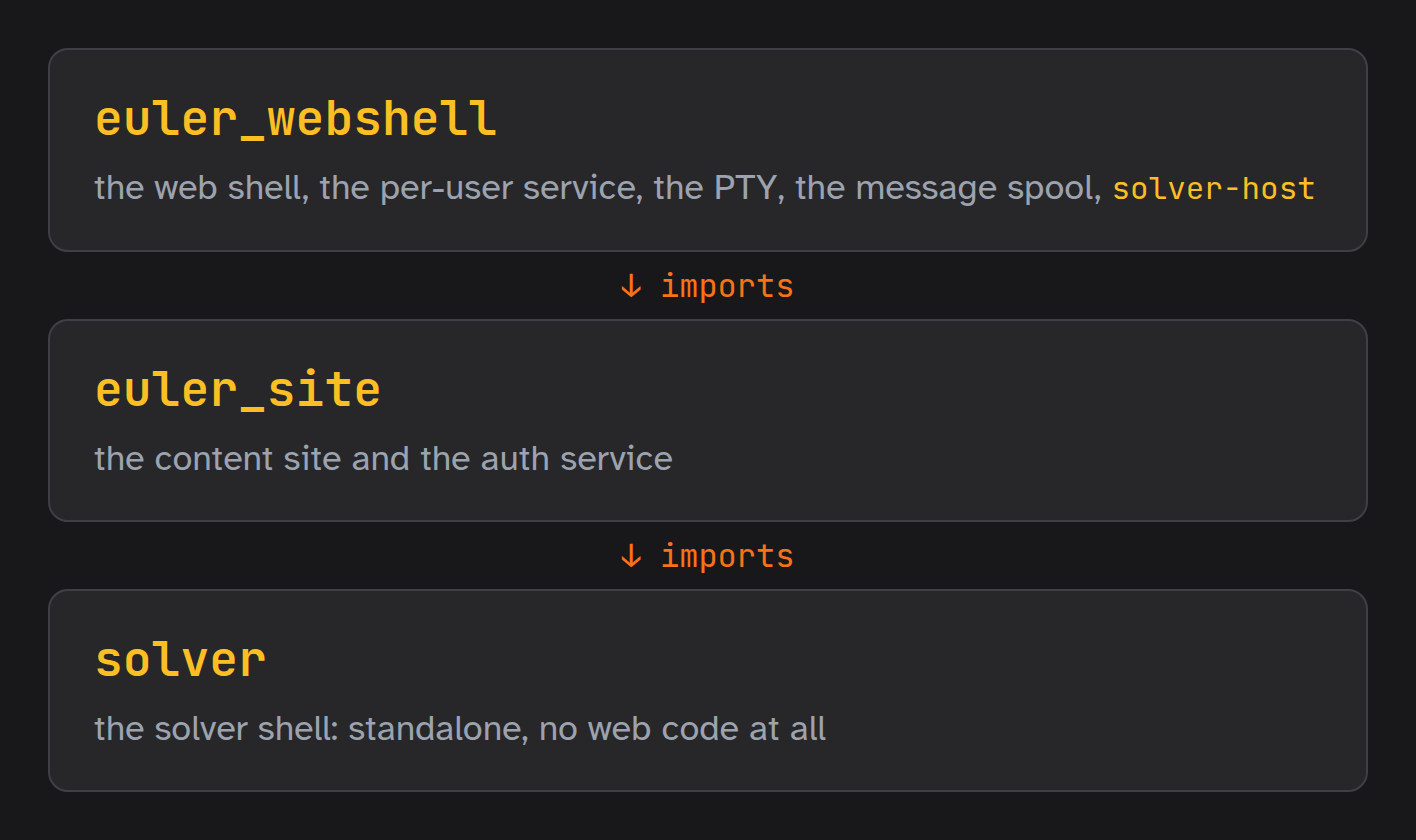
packages/
  solver/    euler-solver    import solver           the solver shell: standalone, no web code
  site/      euler-site      import euler_site       the content site and the auth service
  webshell/  euler-webshell  import euler_webshell   the web shell, the per-user service, the spool
  content/   euler-content   import euler_content    the published content, as data
| Package | What it holds |
|---|---|
| euler-solver | the shell (shell), the domain (core: problems, git, progress), keys and the vault (crypto), the AI commands (ai), the runners, templates, config, and the identity kernel (auth) |
| euler-site | the content app (euler_site.site), the auth service (euler_site.auth), the shared service helpers (cache, csp, store, unixhttp, envfile), the auth pages' templates, and the static tree Caddy serves (content/) |
| euler-webshell | the PTY service (ws), the per-user service (user), the message spool (msg), the web shell itself (shell: OSC, overlays, ticket identity, key distribution, solver-host), the collaborator roster (roster) and the users command (users) |
| euler-content | README.md, docs/, blogs/, solutions/public/, solutions/problems.json and the few package files the pages link to — never solutions/private (§4) |
Dependencies point one way:
euler_webshell → euler_site → solver
The site uses the solver's domain — problems, the progress parser, paths, the identity
kernel — never its shell; nothing in the site imports the web shell. That direction is what
lets the solver shell be installed and run on its own, with no web code in it at all, and
it is enforced rather than hoped for: scripts/linters/layers.py
reads every module of the two lower packages and fails on an import that points up — top-level
or lazy, import x or from x import y — and on a command module in the solver's loader
manifest that is not the solver's own. It runs in the pre-commit hook and in check.sh.
Known exceptions would go in layers.allow, which only
ratchets down; it is empty.
2. Who a session is
packages/solver/solver/shell/login.py settles
two things at startup, run by solver.main.main:
identify()— the subject, before any command module loads, because each command's floor is checked against it as it registers;unlock()— the vault, after the commands and the extension have loaded, so a broken extension refuses the session before anyone is asked for a password.
2.1 Who: the OS login, or the extension's
The solver shell's identity is the OS login of the process's real uid — read from the
password database, never from $USER or $LOGNAME, which the user sets
(auth/identity.py). An extension may bring its
own (§3.1): the web shell redeems the one-time shell ticket its PTY was forked with
(shell/identity.py), refuses to start
without one, and scrubs it from the environment so no child inherits it.
A solver that a web shell starts — claude-solve's headless Claude, a ! solver "…" — is a
plain solver shell: it has no ticket and resolves from its uid, which is the collaborator's
per-user account. §2.2 is what gives it that collaborator's identity and rung.
2.2 Role: a guardrail, not a boundary
The role comes from a policy the user cannot rewrite — /etc/euler/authorizations.json,
root:euler-authz 0640, keyed by e-mail or OS login. Its readers are the auth and message
services and the operator; a collaborator's per-user uid is not one of them. That uid reads its
own row instead: the admin plane publishes each mapped account's entry beside the map as
/etc/euler/profiles/<account> (root:<account> 0640, the map's own shape), so a solver it
runs — claude-solve's headless Claude, a nested solver "…" — still holds its owner's rung:
| Policy deployed? | Login | Role |
|---|---|---|
| yes | listed | its entry |
| yes | the system_slug of a listed e-mail (a per-user web account) |
that e-mail's entry, with the e-mail as the identity |
| yes | anything else | reader |
| yes, but unreadable to this uid | any | its own row (profiles/<login>), resolved as above |
| yes, unreadable, and no own row | any | reader — a policy nobody is visible in, never "no policy" |
| no (a collaborator's own machine) | owns the checkout | admin |
| no | anything else | contributor |
A policy counts only if the file and every directory above it are root-owned and not group- or world-writable. That rules out the two shortcuts that look tamper-proof and are not:
- a root-owned file in
~/.euler/— unlink and rename are governed by the directory's permissions, so the owner of~/.eulercan move the file aside and put their own in its place; - an HMAC of the role in an environment variable — verifying an HMAC needs the secret in the verifying process, and whoever holds the secret can mint one (a token would need a signature instead).
The same rule applies to an EULER_AUTHZ_FILE override, and to a row under profiles/: one
the user can write is ignored.
An unreadable policy is still a deployed one. Reading it as absent would hand every checkout
owner on the host — each collaborator owns their clone — admin. The operator reads it through
euler-authz membership, and has a row of their own besides, so a terminal opened before that
membership was granted still resolves to their rung.
The rows are kept in step with the map by everything that writes it: the admin plane's
users add / change / remove, auth.sh (deploy and redeploy), and user.sh provision /
deprovision — a row needs its account's private group to exist, and users add writes the
map before provisioning creates the uid. An account without its own private group gets no row.
Even so, the role is a guardrail. Inside one uid — where the user can edit their clone, run
!, or call Python directly — no in-process check can stop them. The role prevents accidents
and shapes the command set; the boundaries are elsewhere: uids and file permissions,
separate-uid services checking SO_PEERCRED, the master key, and GitHub's protection of
master. Every maintainer and admin command was audited for where its effect actually
lands and what stops a lesser profile there:
authorizations.md § Where it is enforced.
None depends on its floor alone.
2.3 The vault: a capability, not a proof of identity
unlock() tries EULER_VAULT_KEY_FILE, then EULER_VAULT_PASSWORD, then a terminal prompt —
unless the extension says prompt_vault=False (the web shell: the browser unlocks the vault,
and a shell that stopped to ask would stall every attach). Unlocking proves possession of the
vault password; the uid has already said who this is. What it grants is the master key and
the API key, and commands that need them check the key file where they need it.
3. Extending the shell
The solver shell never discovers code. A package that builds on it hands
solver.main.main(extension=…) an Extension
(shell/extension.py). Composition is explicit on
purpose: plugin discovery (entry_points) would load web commands into every shell of a venv
the web package is installed in — a developer's terminal included.
3.1 The extension
| Field | What it adds | The web shell's |
|---|---|---|
modules |
command modules imported after the shell's own | HOST_COMMANDS: users, msg, key distribution |
overlays + notify |
events after a command, or a replacement body (§3.2) | overlays.toml, and osc.nudge |
identity |
who the session is, instead of the OS login (§2.1) | the shell ticket |
prompt_vault |
whether a locked vault may be unlocked by prompting (§2.3) | no |
on_start |
a step before the banner, which reports the state it leaves; returns a line for under the banner | a quiet git-sync, with one line if it failed |
notices |
the carrier for staff notices (§3.3) | the message spool |
handoff |
told when an interactive child (! sh, ! py, claude) takes the terminal and gives it back |
osc.handoff: busy / ready, which disable the page's command-typing controls |
working |
told when the interactive shell leaves its prompt to run a block and comes back | osc.working: running / idle, which the per-user service follows to tell work from an idle prompt |
3.2 Overlays
An overlay table is TOML, one table per command:
[git-commit]
emit = ["git"]                                   # notify("git") after the command returns

[show]
replace = "euler_webshell.shell.viewer:show"     # run this body instead; same signature
emitfires after the command whatever its exit code: every event is an idempotent "re-read" nudge, and a failed command may still have changed state. It is coarser than an emit placed inside a command — a long command moves the chip at its end — and that is the price of a solver shell that knows nothing of the page.replaceruns another function behind the original's contract: the same parsing, coercion, help and usage. Its signature must match the original's exactly (Askmetadata aside).- An overlay that names no command or only an alias, a replacement that does not fit, or an
emitwith nonotify, stops the shell from starting. Every overlay is checked before any is applied, so a half-applied table never runs. An overlay on a command the subject is below the floor of is skipped, not refused.
The web shell's table makes the state-changing commands refresh the header's chips and the
solutions grid, and replaces show / edit with bodies that swap the page's left pane
(viewer.py); key-rekey gains the
re-issue to every registered holder. The generated table What the web shell changes in the
command catalogue lists it all, and tests/test_web_shell.py checks
the real tables against the full registry.
3.3 Notices
Some commands finish by handing work to somebody else: git-push opens a pull request a
maintainer lands, summary finds answers nobody registered, user mints a key that needs
issuing, a merge dismisses the review notice. The text depends on what the command found half
way through, which an overlay cannot express, so the solver names the notice and an extension
delivers it (core/notices.py):
from solver.core import notices
from solver.core.notices import PR_REVIEW_SUBJECT

if not notices.to_staff(f'{PR_REVIEW_SUBJECT}{branch}', body):
    console.print('…tell a maintainer yourself…')
With no carrier installed nothing is sent and the call returns False, so the command says
what to do by hand. The subjects live in the same module because they are a contract between
the commands that file them and the spool that reads them (its chip offers merge on a review
row and save on a key row). notices.key_hint() is the carrier's wording for where a waiting
master key is taken: the header's message chip over the web, msg act on the host,
host-unlock anywhere else.
3.4 Which shell has which command
| Shell | Run as | Commands |
|---|---|---|
solver |
solver, python -m solver |
the solver package's |
| the web shell | python -m euler_webshell.shell — what the browser's terminal runs |
those, overlaid (§3.2), plus the web host's |
solver-host |
solver-host, python -m euler_webshell.shell.host — the operator's terminal on the web host |
the solver's plus the web host's; the OS login, a terminal vault prompt, no OSC |
The web host's commands — msg, users, user-authorize, key-split, host-authorize — live
in euler-webshell because they need what only the host has: the message spool, the roster, the
mail relay. The command catalogue is split the same way.
Because the generated docs cover both sets, update-docs and check-commands run from
solver-host; a plain solver refuses update-docs where the web shell is installed rather
than silently dropping its commands from the docs.
4. Two content roots: the public site and your clone
One app (euler_site/site/app.py) serves the content
from one of two roots:
| Visitor | Served by | Root | Surface |
|---|---|---|---|
| not signed in | euler-site (EULER_SITE_PUBLIC=1) — build_public_app |
the installed euler-content tree |
read routes only; no identity, no git, no terminal, no account, no writes |
| signed in | their own euler-user@<slug> instance |
their ~/euler clone |
everything, by profile |
The docs, blogs and public solutions are published unencrypted on GitHub anyway, so asking for
a login to read them protected nothing. What the public site cannot show is structural, not a
check: the content wheel holds no solutions/private, and its unit runs on a uid of its own with
ProtectHome=true and AF_UNIX only, so no clone is visible to it. Caddy picks the root by the
session cookie — a GET of a content path with no solver_session / solver_remember cookie
goes to the public site — which is not a trust decision, since either copy is public content to
whoever asks. The web server guide § 11.0 has the routing and the
templates' browsable / subject split.
4.1 The content wheel
scripts/content/stage.py builds the wheel's source in a scratch
directory: a copy of packages/content/, the public tree laid into euler_content/tree/
in the repository's own layout, and _version.py stamped from the solver's version. It copies
tracked files under fixed public roots only — an untracked scratch file never ships — and
refuses outright if anything under solutions/private would be included. euler_content.root()
returns the installed tree, and the content readers take it exactly as they take a clone.
Besides the docs, blogs and public solutions, the roots take in the code the public site's code
viewer shows (/code/: packages/, scripts/ and the root config files — web server guide
§ 11.5, The code viewer), so the wheel is also the one copy of the code that page reads.
The public copy is as current as the last deploy: every venv deploy re-stages and reinstalls
it, so make redeploy-web refreshes it with the code. That is also what lets its pages be
cached: each carries an ETag from a fingerprint of the installed tree and the site package,
revalidated on every use and answered with a 304 without rendering (web server guide § 11.10).
5. Building, versioning, deploying
5.1 Installing
Each package has its own pyproject.toml; the root one is no package — it records the system
setup the packages need. Install the three together, so the pins between them resolve
against each other rather than an index:
pip install -e "packages/solver[ai,dev,show,solutions]" -e packages/site -e packages/webshell
That is what make install-all runs (make install-minimal: fewer solver extras). A machine
that only solves problems needs only the first. /opt/euler, the services' venv, gets the
same three, non-editable, plus euler-content (scripts/setup/venv.sh).
The git filter runs python -P -m solver.crypto.gitfilter from the dev venv, so an editable
install pointing at a path that has moved breaks every git command that touches
solutions/private until the venv is reinstalled.
5.2 One version
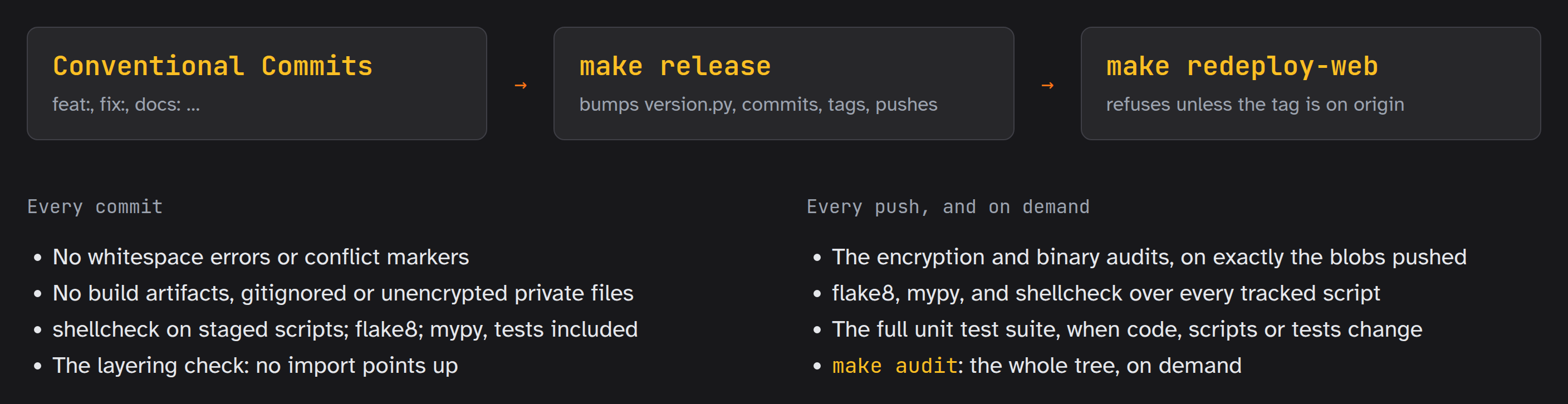
The packages version in lockstep: one number, one tag. scripts/version/release.sh
(make release) is the only writer — it derives the bump from Conventional Commits, rewrites
every package's version.py and the euler-solver==X.Y.Z / euler-site==X.Y.Z pins in the
site's and web shell's pyproject.toml, commits, tags and pushes. The content wheel takes the
solver's number at staging time. Never hand-edit a number.
5.3 Redeploy versus upgrade
| Change | Run |
|---|---|
| code, templates, CSS/JS, content | make release, then make redeploy-web |
| a module a unit starts, a unit file, a package's place | make release, then make upgrade-web |
redeploy-web reinstalls the venv and restarts the services against it, but re-lays no unit:
a unit that names a module the new code no longer has would fail to start. upgrade-web
re-lays every unit and stops every running per-user instance, whose socket restarts it on the
next request — an instance left running keeps the code it started with, and once pip has
replaced that code on disk every page it renders fails.
6. Keys across the split
The solver shell holds and receives keys: user (your key pair), vault, key-reconstruct
(complete a key from two halves), host-unlock (install a sealed block), a local key-rekey,
and key-export, which prints the master key sealed to a public key, to carry by any channel
you trust. That is all a standalone machine needs.
Sending keys needs what only the web host has, so it is the web shell's
(shell/keys.py): user-authorize and
key-split (half the master key over the spool, recorded in the roster), host-authorize (the
whole key, sealed, by mail through the relay), and key-rekey's re-issue to every registered
holder, as an overlay replacement. The gitfilter guide § 6 walks through
granting and rotating.
7. Tests
| Test | Holds |
|---|---|
tests/test_layers.py |
the layering checker, and the repository clean against its allowlist |
tests/test_extension.py |
overlays: emit, replace, the signature check, the refusals, atomic application; notices install |
tests/test_web_shell.py |
the web shell's and the host's real overlay tables against the registry; the ticket identity; the start-up sync; OSC |
tests/test_auth_kernel.py |
the OS-login identity and the role chain, including a policy the user can write |
tests/test_public_site.py |
the staged content holds nothing private; the public app's read-only surface; identity headers ignored |
tests/test_enforcement_audit.py |
every maintainer / admin command has a row in the enforcement audit, at its floor |
8. How it got here
The three packages were one solver package with the web tier under solver/web/. They were
separated in seven steps (October 2026), each shipped and deployed on its own:
| Step | What moved |
|---|---|
| 1 | the layering checker and the extension mechanism |
| 2 | OSC: the solver's commands stopped writing escape codes; the web shell overlays them |
| 3 | login; the ticket identity left the solver; the role from the root-owned policy |
| 4 | key distribution and staff notices to the web side; the allowlist empty; solver-host |
| 5 | the public site and the content wheel |
| 6 | the physical move into packages/, three pyprojects, lockstep releases (v4.0.0) |
| 7 | the enforcement audit; the catalogue split by shell |
The old module paths mapped one for one: solver.web.X became euler_site.X (site, auth, the
shared helpers) or euler_webshell.X (ws, user, msg, shell); solver.auth.roster became
euler_webshell.roster, and solver.web.auth.commands became euler_webshell.users.
9. Files
| File | Role |
|---|---|
packages/*/pyproject.toml |
one per package: dependencies, pins, package data |
shell/extension.py |
Extension, overlays, load_extension |
shell/login.py |
identify() and unlock() |
auth/identity.py |
the OS login and the role chain |
core/notices.py |
the notices hook and the notice subjects |
euler_webshell/shell/ |
the web shell: extensions, overlays, identity, keys, notices carrier, OSC |
scripts/content/stage.py |
stages the content wheel |
scripts/linters/layers.py |
the layering guard |
scripts/version/release.sh |
the lockstep release |